

Sodium Hyaluronate: Science-Backed Guide for Cosmetic Formulators & Skincare Enthusiasts



Core Benefits of Sodium Hyaluronate for Skin
Sodium hyaluronate is famous for binding up to 1000 times its weight in water, yet its skin benefits go far beyond simple surface moisturization. Modern research has proven multi-dermal advantages closely related to molecular-weight differences.
First, powerful humectation and skin-barrier support. High-molecular-weight sodium hyaluronate forms a breathable hydrating film on the stratum corneum, lowering transepidermal water loss (TEWL) and locking surface moisture for hoursMDPI. Clinical observations show well-formulated topical sodium hyaluronate can elevate skin hydration level by roughly 10% after consistent twice-daily application. Low-molecular-weight fractions can penetrate deeper into epidermal layers, promoting keratinocyte differentiation and reinforcing barrier integrity, which brings relief for dry and barrier-impaired skinMDPI.
Second, visible improvement on fine lines and Skin elasticity. Skin endogenous hyaluronic acid gradually degrades with aging and UV exposure, resulting in reduced dermal hydration and shallow wrinklesSemantic S.... In-vitro studies indicate low-molecular-weight sodium hyaluronate helps stimulate type-I collagen expression and inhibits MMP-1, an enzyme that breaks down dermal matrix proteinsPMC. Human clinical data notes that long-term topical use reduces wrinkle depth by approximately 10% and lifts skin elasticity by around 20% in test subjects.
Third, soothing and post-procedure skin care. Sodium hyaluronate exhibits mild anti-inflammatory effects, easing irritation after chemical peeling, laser or other aesthetic treatments, and accelerating epidermal recoveryPMC. For sensitive skin populations, it reduces tightness and stinging sensations without triggering extra irritation responses.
FAQ: Does sodium hyaluronate fill deep wrinkles topically? Answer: Topical sodium hyaluronate cannot physically fill deep wrinkles like injectable hyaluronic-acid fillers. Its anti-aging effect mainly relies on hydration plumping and matrix-support mechanisms to soften superficial fine lines.
How to Use Sodium Hyaluronate in Cosmetics
For cosmetic formulators, how to use sodium hyaluronate in cosmetics covers recommended concentration, molecular-weight selection, pH range and formulation compatibility, which directly decide finished-product performance.
The typical usage concentration of cosmetic-grade sodium hyaluronate ranges from 0.01 % to 2.0 %, and most commercial skincare formulas adopt 0.05 %-0.2 % to balance cost, texture and hydrating output. Excessively high dosage will cause sticky, stringy texture, hurting user sensory experience. The optimal formulation pH sits between 5.0-7.5, matching skin physiological pH; extreme high-low pH will degrade sodium hyaluronate polymer chains and weaken its performance.
Molecular-weight matching is critical. High-molecular-weight sodium hyaluronate (1 MDa-3 MDa) is suitable for moisturizing cream, lotion and mask, building surface hydrating film. Low-molecular-weight or hydrolyzed sodium hyaluronate (10 kDa-100 kDa) is preferred for serums targeting deeper-layer care. Many mainstream brands apply blended multi-molecular-weight sodium hyaluronate, combining instant surface hydration and long-term epidermal nourishment, which has become a popular formulation strategy in recent years.
Practical formulation tips: Disperse sodium hyaluronate powder in glycerin or propylene glycol first before adding to aqueous phase to avoid lump formation. High-temperature long-time sterilization shall be avoided; low-temperature sterile filtration is the better processing choice. It works synergistically with glycerin, panthenol, ceramides and other barrier-repair ingredients, while strong oxidizing raw materials may accelerate its molecular degradation.
Applicable product categories cover hydrating serums, facial creams, sheet masks, eye care items, after-sun products, sensitive-skin repair cosmetics, and even foundation and hair-care formulas for smoothing skin and hair cuticle.
Is Sodium Hyaluronate Safe for Skin? Evidence-Based Safety Analysis
Is sodium hyaluronate safe for skin is one of the most-searched questions from consumers and brand compliance teams. Multiple authoritative regulatory assessments and clinical trials provide solid safety conclusions.
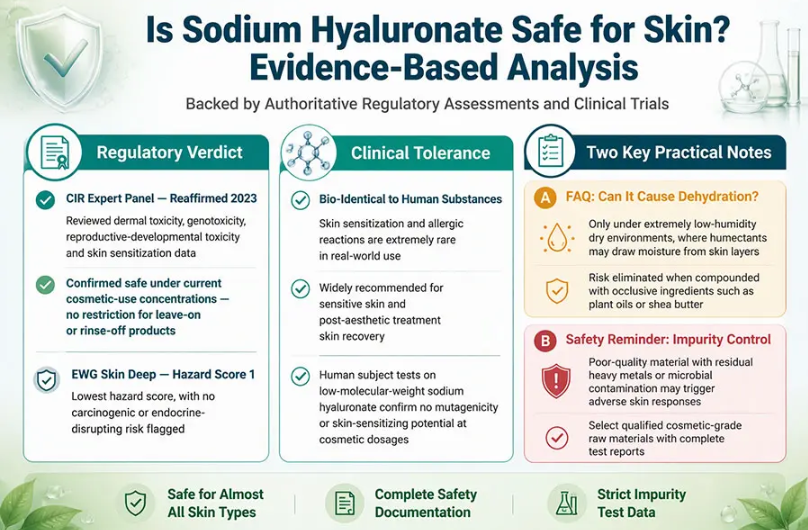
The Cosmetic Ingredient Review (CIR) Expert Panel completed comprehensive safety evaluation on sodium hyaluronate, with the latest re-affirmation published in 2023. They reviewed dermal toxicity, genotoxicity, reproductive-development toxicity and skin sensitization data, and confirmed sodium hyaluronate is safe under current cosmetic-use concentrations, with no restriction for leave-on and rinse-off cosmetic products. EWG Skin Deep database assigns sodium hyaluronate the lowest hazard score 1, with no carcinogenic, endocrine-disrupting risk flagged.
Since sodium hyaluronate is bio-identical to substances naturally produced inside human bodies, skin sensitization and allergic reactions are extremely rare in real-world use, and it is widely recommended for sensitive skin and post-aesthetic-treatment skin recovery scenariosPMC. Human subject tests with low-molecular-weight sodium hyaluronate also confirm no mutagenicity or skin-sensitizing potential under cosmetic application dosagesSemantic S....
FAQ: Can sodium hyaluronate cause skin dehydration? Answer: Only under extremely low-humidity dry environments. If ambient air moisture is insufficient, humectants may draw moisture out from skin layers. This risk can be eliminated when sodium hyaluronate is compounded with occlusive ingredients such as plant oils or shea butter in finished formulas.
Safety reminder: Raw-material impurity control matters. Poor-quality sodium hyaluronate with residual heavy metal or microbial contamination may trigger adverse skin responses, hence manufacturers should select qualified cosmetic-grade raw materials with complete test reportsPMC.
Market Development Direction of Sodium Hyaluronate
Driven by rising consumer demand for hydration-oriented, clean-beauty skincare, the global cosmetic-grade sodium hyaluronate raw-material market keeps stable expansion. Industry statistics show the cosmetic-grade sodium hyaluronate market will grow at CAGR 6.4% from 2026-2034, reaching USD 687.9 million by 2034. Several clear development directions stand out.
First, multi-molecular-weight compounding and modified derivative boom. Beyond conventional high-/low-molecular-weight sodium hyaluronate, acetylated sodium hyaluronate, cross-linked sodium hyaluronate and liposome-encapsulated sodium hyaluronate gain popularity. Novel delivery technology improves molecule stability, prolongs hydration duration and optimizes skin-penetration effect, supporting differentiated product claims for brands.
Second, clean-beauty and sustainable-production requirements increase. Buyers prefer raw materials from microbial fermentation (replacing animal-tissue extraction), with eco-friendly production procedures and international clean-beauty certifications like COSMOS and ECOCERT. Biodegradability has become one key purchasing index for global cosmetic brands.
Third, application-scenario expansion. Apart from traditional facial skincare, sodium hyaluronate is expanding into hair-care, scalp-repair, color-cosmetic base formula and oral beauty-supplement fields, opening new growth space for raw-material suppliers.
Fourth, stricter global compliance requirements. Formulators and raw-material suppliers need to keep up-to-date with cosmetic-ingredient regulatory updates across EU, United States and Asia-Pacific markets, supplying complete safety-assessment documents and impurity test data for finished-product registration.
Conclusion
As a well-researched, high-performance cosmetic humectant, sodium hyaluronate delivers proven skin-hydrating, barrier-supporting and anti-aging auxiliary benefits when properly formulated. Ample regulatory documents and clinical data back its excellent skin-safety profile for almost all skin types. Moving forward, multi-molecular compounding, innovative delivery systems and sustainable manufacturing will define the evolution of sodium hyaluronate raw-material market. Whether you are cosmetic raw-material buyer, formulator or skincare consumer, understanding its molecular-weight features, formulation rules and safety facts helps you make more informed product and usage decisions.
Xi'an Aoge Biotech Co., Ltd.
Xi'an Aoge Biotech Co., Ltd.
Legal Disclaimer:
EIN Presswire provides this news content "as is" without warranty of any kind. We do not accept any responsibility or liability for the accuracy, content, images, videos, licenses, completeness, legality, or reliability of the information contained in this article. If you have any complaints or copyright issues related to this article, kindly contact the author above.
