

Tubulin-β (TUBb): Cytoskeleton Molecular Machinery — Essential Target & Tool for Life Science Research
Validated monoclonal antibody from Cloud-Clone enables multi-assay exploration of microtubule biology across basic and translational research
HUSTON, TX, UNITED STATES, September 16, 2026 /EINPresswire.com/ -- Microtubules constitute the backbone of the eukaryotic cytoskeleton, orchestrating cell shape maintenance, intracellular trafficking and mitotic progression. As the core building block of microtubules, tubulin-β (TUBb) sits at the centre of research spanning cell biology, oncology and neuroscience. Reliable antibody reagents are critical for researchers to characterise TUBb expression, subcellular localisation and post-translational modification. Cloud-Clone presents its well-validated anti-TUBb monoclonal antibody (Catalog No. CAB870Hu22), delivering consistent performance across Western Blot, immunohistochemistry and immunofluorescence to support global scientists investigating cytoskeleton-driven biological processes.
Within the microscopic environment of eukaryotic cells lies a sophisticated, dynamic cytoskeletal system. It sustains cellular morphology, powers intracellular material transport, and governs cell division and proliferation — forming the foundational architecture for cellular life activities. Microtubules represent a key component of this cytoskeleton, and β-tubulin (TUBb) serves as the primary functional mediator of microtubule activity.
Beyond assembling microtubular structures, TUBb acts as a pivotal research target for investigating cellular dynamic regulation, tumour onset and neural development. It remains a high-interest research subject across life-science disciplines, ranging from fundamental exploration of cellular mechanisms to anti-tumour drug discovery and pathological analysis. This article provides a comprehensive breakdown of TUBb, covering its molecular characteristics, structural-functional relationships, regulatory mechanisms, specialised antibody tools and multi-scenario laboratory applications to aid researchers working on this core target.
Getting to Know TUBb: Core Functional Unit of the Cellular Microtubule System
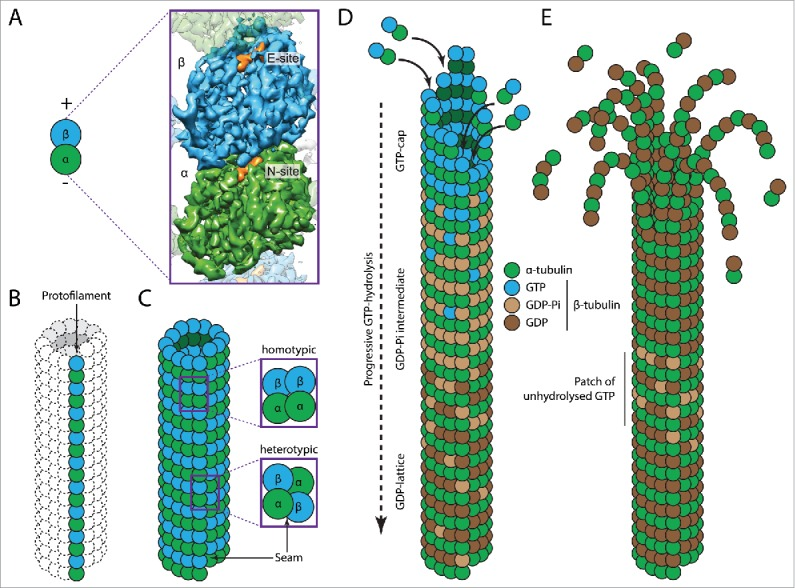
Microtubule assembly relies on the cooperative interaction between α-tubulin and β-tubulin (TUBb). The two proteins form stable α/β heterodimers, which serve as the basic subunits for microtubule biogenesis. As a key member of the tubulin family, TUBb consists of 455 amino acids with a molecular weight of approximately 55 kDa. It is broadly expressed in the cytoplasm of all eukaryotic cells and exhibits high cross-species conservation.
Unlike static cellular frameworks, TUBb-containing microtubules possess pronounced dynamic instability. They rapidly assemble and disassemble in response to cellular physiological states and participate in three major biological functions:
1.Structural support: Forming the main scaffold of the cytoskeleton to preserve cell shape, resist mechanical stress and maintain cellular homeostasis.
2.Intracellular transport: Acting as intracellular “transport tracks”. Together with motor proteins, microtubules mediate long-range trafficking of vesicles, organelles and biomacromolecules, and are especially critical for axonal transport in neurons.
3.Regulation of cellular life cycles: Driving spindle apparatus assembly during mitosis and mediating accurate chromosome segregation, which directly determines the outcome of cell proliferation. TUBb also contributes to cilia and flagellar motility, and modulates cell migration and sensory functions.
Figure 1 Schematic diagram illustrating the complete microtubule assembly pathway (heterodimer → protofilament → hollow microtubule)
In-depth Analysis of TUBb: Specialised Structure Enables Multifaceted Regulatory Capacity
α-tubulin and TUBb share around 40 % amino-acid sequence identity. Each monomer adopts a compact globular fold built from β-sheets and surrounding α-helices. Functional specificity arises from the precise division of labour among three key structural domains, all of which represent valuable research entry-points:
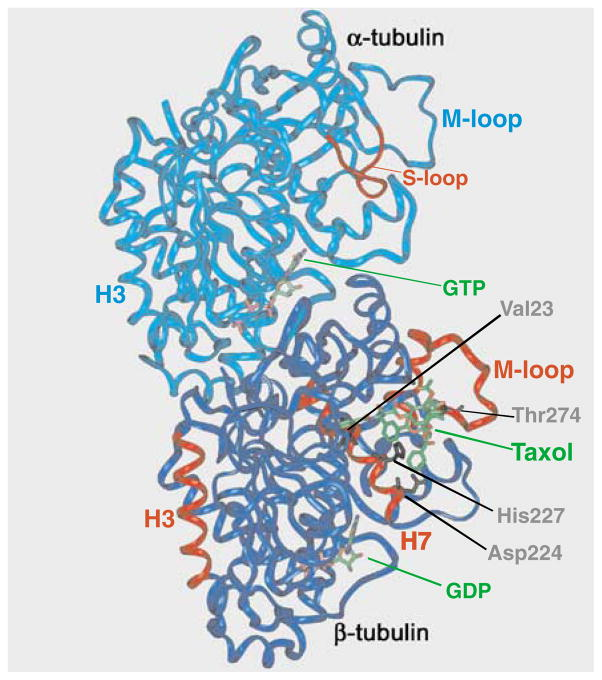
1.N-terminal nucleotide-binding domain: Power hub for microtubule dynamics This region harbours the exchangeable GTP-binding E-site, the energy and regulatory core for microtubule polymerisation. During microtubule assembly, GTP-bound TUBb forms a stabilising cap that locks microtubule architecture and promotes polymerisation. Hydrolysis of bound GTP into GDP reduces structural stability and triggers disassembly. This assembly-disassembly cycle underpins microtubule dynamic instability and enables rapid cellular adaptation to physiological changes.
2.Intermediate domain: Primary binding pocket for targeted anti-tumour therapeutics The intermediate domain of TUBb constitutes a major target for clinically used anti-cancer agents. Paclitaxel (Taxol), a widely applied anti-tumour drug, binds specifically within this domain. Binding locks TUBb in a stable conformation, suppresses microtubule disassembly and blocks spindle breakdown. This ultimately halts cancer-cell mitosis and restrains tumour proliferation. The intermediate domain continues to be a priority target for developing novel microtubule-directed anti-cancer candidates.
3.C-terminal acidic domain: Modification platform for functional tuning The highly acidic flexible C-terminal tail of TUBb projects outwards from the microtubule surface. It fulfils two principal roles: it serves as the docking site for motor proteins such as kinesins and dyneins, directly governing intracellular transport efficiency; it also accepts post-translational modifications including polyglutamylation and polyglycylation. By altering surface charge and conformation, these modifications fine-tune microtubule stability and biological performance.
Figure 2 Three-dimensional structure of the α/β-tubulin heterodimer
The Tubulin Code: Mechanisms Underpinning Functional Plasticity of TUBb
How can tubulin molecules support distinct functional requirements across different tissues and physiological conditions? The answer lies within the tubulin code, a dual-layer regulatory system formed by TUBb isotype diversity and reversible post-translational modifications that confer extensive functional plasticity.
The human genome encodes at least seven TUBb isotypes (βI, βII, βIII and others) with strict tissue-specific expression patterns. The βI isotype is ubiquitously expressed and participates in cytoskeleton formation in most cell types. The βIII isotype is highly enriched in neurons; it acts as a marker for neural development and nerve-injury repair, and aberrant βIII expression correlates with neurodegenerative disorders and tumour neural invasion. Different isotypes interact differentially with microtubule-associated proteins (MAPs) to precisely tune microtubule stability and dynamic behaviour.
Reversible post-translational modifications occurring on the TUBb C-terminus represent another major mechanism for fine-tuning microtubule performance. For instance, polyglutamylation adds glutamate side-chains of variable lengths, modifying microtubule surface charge to adjust motor-protein binding affinity and movement velocity. This process is indispensable for long-range neuronal transport and ciliary function. Such multi-level, finely-tuned regulation enables microtubule structures to execute sophisticated cellular tasks.
Core Research Reagent: Cloud-Clone Anti-Tubulin Beta (TUBb) Monoclonal Antibody (Catalog No. CAB870Hu22)
TUBb possesses intricate structural features, diverse isotypes and multiple modified forms. Accurate measurement of its expression level, spatial distribution and dynamic changes demands antibodies with high specificity and broad compatibility. Cloud-Clone’s anti-Tubulin Beta (TUBb) monoclonal antibody (Catalog No. CAB870Hu22) addresses common experimental pain-points including off-target binding, limited species cross-reactivity and narrow assay compatibility, and serves as a robust tool for basic mechanistic research and pathological detection.
Key Product Advantages
- High purity and high specificity: Mouse-derived monoclonal antibody purified by Protein A+G affinity chromatography delivers high purity and low background signal. It specifically recognises human TUBb with minimal non-specific interactions.
- Broad cross-species reactivity: Validated for detection of TUBb from human, rat, dog, bovine and zebrafish samples. It supports cross-species comparative work and mechanistic studies using model organisms, helping to reduce experimental costs.
- Convenient and stable storage conditions: Supplied at a working concentration of 1 mg/mL in 0.01 M PBS containing 0.05 % Proclin-300 and 50 % glycerol. It exhibits strong stability under low-temperature storage and is ready-to-use for major molecular-biology assays without extra formulation steps.
Multi-application Research Performance: Coverage for Basic Research and Pathological Analysis
Benefiting from outstanding specificity and compatibility, CAB870Hu22 is suitable for three mainstream experimental workflows: Western Blot, immunohistochemistry (IHC) and immunofluorescence (IF). It supports cell-mechanism investigation, protein quantification, in-situ tissue pathological profiling and cytoskeleton morphology analysis.
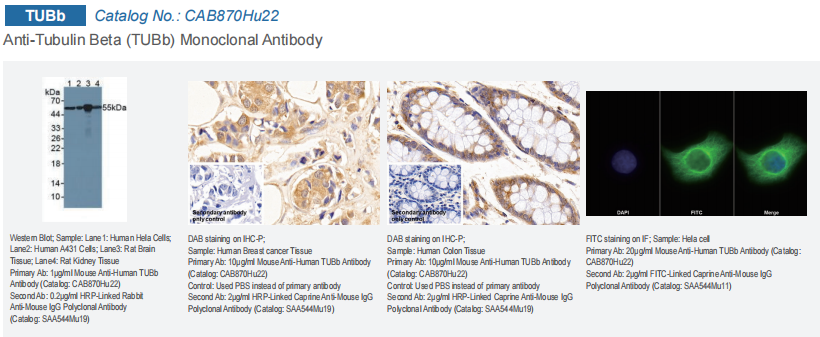
1.Western Blot: Dual utility as classic loading-control reference and target-protein quantifier TUBb is stably and constitutively expressed in most cells and tissues with minimal expression fluctuation, making it a well-established loading-control reference. This antibody reliably detects TUBb from human tumour cell lines including HeLa and A431, as well as multiple rat tissue samples. Researchers may employ TUBb signals to normalise sample loading and mitigate experimental variation. It can also directly quantify differential TUBb abundance in pathological models, to assess how cell proliferation, tumour progression or drug intervention perturb the microtubule system.
2.Immunohistochemistry (IHC): Pathological localisation analysis at tissue level Within DAB staining workflows, this antibody clearly labels TUBb in pathological specimens such as human breast-cancer and colon tissues, visualising protein distribution and relative expression abundance. Negative controls substituting primary antibody with PBS eliminate non-specific staining and ensure reliable results. This assay fits applications including tumour pathological subtyping, tissue-damage evaluation in disease models and histological validation of drug therapeutic effects.
3.Immunofluorescence (IF): Visualising cytoskeleton dynamics When paired with FITC-conjugated secondary antibodies, the antibody enables high-resolution fluorescent labelling of microtubule networks in fixed or treated cells. Researchers can visualise full microtubule architecture, orientation and dynamic rearrangement. This allows direct observation of cytoskeleton remodelling triggered by drug exposure, gene knockout or pathological injury, and constitutes a powerful visual tool for studying cell-shape regulation, cell migration, spindle defects and neuronal cytoskeleton impairment.
Figure 3 WB, IHC and IF application of Anti-Tubulin Beta (TUBb) Monoclonal Antibody (Product No.CAB870Hu22)
Conclusion: Research Value and Future Outlook for TUBb Studies
From a fundamental biological perspective, TUBb functions as a core “molecular machine” sustaining cellular homeostasis and governing cell-cycle events. Dynamic changes to its structure and post-translational modifications hold the key to deciphering mechanisms behind cell proliferation, differentiation and migration. From a translational viewpoint, TUBb represents a high-value target for anti-tumour and neurological-disease therapeutics, with irreplaceable importance in drug discovery, pathological diagnostics and mechanistic investigation.
Cloud-Clone’s CAB870Hu22 anti-TUBb monoclonal antibody combines high specificity, broad-species reactivity and multi-assay compatibility. It supports end-to-end research workflows spanning molecular structure interrogation, cellular functional characterisation and tissue-level pathological profiling. This reagent meets demands for basic mechanistic exploration while also empowering applied studies such as drug screening and pathological assessment, serving as a dependable resource for scientists investigating microtubules and cytoskeleton biology.
About Cloud-Clone Corp.
Cloud-Clone Corp. is dedicated to the development and production of high-quality immunoassay reagents and detection solutions. With a focus on antibody engineering, multiplex assay development, and cross-platform compatibility, the company provides research tools designed to support precision medicine and advanced biomedical investigation globally. Our core products and services include the research and development of proteins, antibodies, ELISA kits, primary cells, and multiplex cytokine assay kits, as well as professional CRO services to fully meet the diverse needs of biomedical research and related fields.
For more information about Cloud-Clone Corp, visit www.cloud-clone.com.
CLOUD-CLONE CORP.(CCC)
Tel: 001-832-538-0970, 0086-27-8425-9552
Email: mail@cloud-clone.com, sales@cloud-clone.us
Visit us on social media:
LinkedIn: https://www.linkedin.com/company/cloud-clone-corp/
Instagram: https://www.instagram.com/cloudclonecorp2023/
TickTok: https://www.tiktok.com/@cloudclonecorp2026
SuKi Duan
CLOUD-CLONE CORP.WUHAN
email us here
Visit us on social media:
LinkedIn
Instagram
TikTok
X
Legal Disclaimer:
EIN Presswire provides this news content "as is" without warranty of any kind. We do not accept any responsibility or liability for the accuracy, content, images, videos, licenses, completeness, legality, or reliability of the information contained in this article. If you have any complaints or copyright issues related to this article, kindly contact the author above.
