

From Control to Trust: New PsychTests' Study Reveals How Delegation Style Predicts Leadership Effectiveness

Micromanaging suffocates potential, but delegation breathes life into it.
Sharing tasks is sharing trust, and trust builds stronger teams.
Psychtests - Insight at your fingertips
New research links delegation style to leadership impact—empowerment fuels growth, control slows it down.
ROSEMERE, QUEBEC, CANADA, July 8, 2026 /EINPresswire.com/ -- A large-scale study conducted by PsychTests examining 1,870 current and aspiring managers reveals a powerful insight: how a leader delegates is not a minor management habit—it is a direct indicator of trust, confidence, and long-term performance.
The research identified five distinct delegation styles, each reflecting deeper psychological patterns that shape team culture and results. The research team used MANSSA - the Management Skills and Style Assessment, which evaluates in depth the leadership abilities and managerial and delegation style of the person.
THE FIVE DELEGATION ARCHETYPES
1. The Task Tyrant
Delegates primarily to assert authority or reduce personal workload.
2. The Cautious Delegator
Delegates selectively and conservatively, typically only to proven high performers.
3. The Task Martyr
Avoids delegation out of fear of appearing incompetent or unnecessary.
4. The Task Skeptic
Distrusts employees’ abilities and hesitates to transfer responsibility.
5. The Empowering Delegator
Delegates intentionally to develop talent, build trust, and expand capability across the team.
WHAT THE DATA REVEAL
The five delegation styles produce markedly different leadership patterns:
Empowering Delegators — The Performance Multiplier
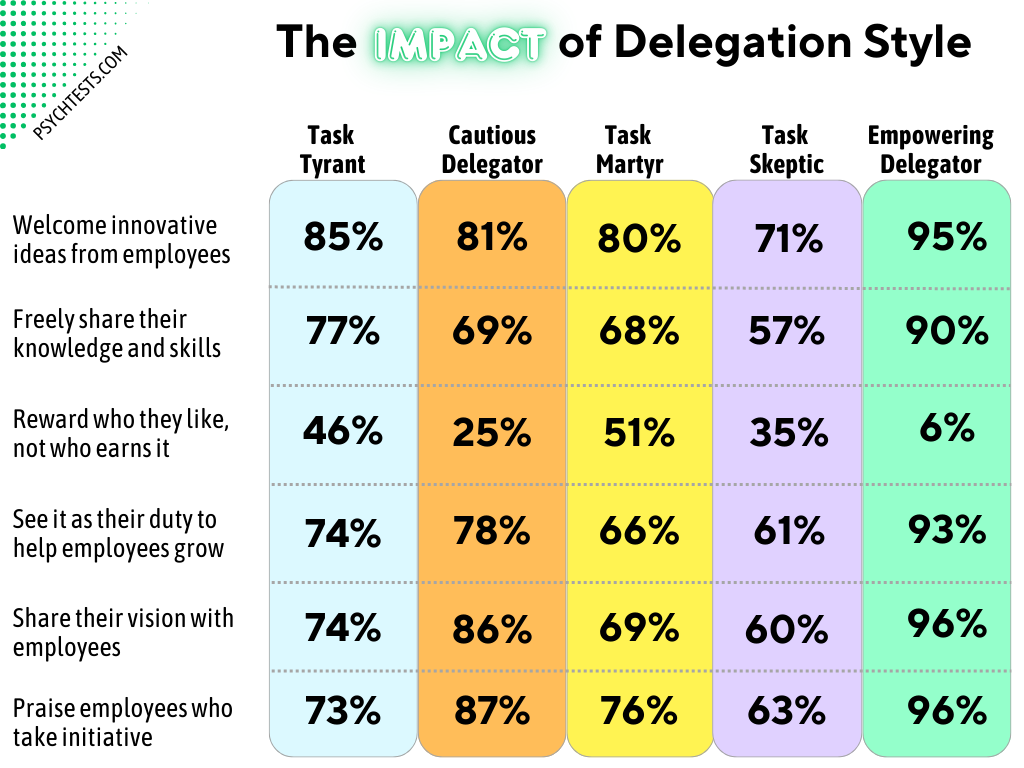
• 95% welcome innovative ideas from employees
• 96% openly share their vision
• 93% believe it is their responsibility to help employees reach their full potential
These leaders view delegation as development. Trust is intentional. Growth is structural.
Task Skeptics — The Trust Deficit
• Only 57% are willing to share their knowledge
• Just 39% believe work can be done efficiently without micromanagement
Distrust constrains scale. When leaders hesitate to release authority, they create dependency instead of capability.
Task Tyrants — Control Over Collaboration
• 71% believe employees perform best when told exactly what to do
Strict control may create compliance, but it suppresses initiative, creativity, and ownership.
Cautious Delegators — Limited Expansion
• 78% feel responsible for helping employees develop their potential
While well-intentioned, their selective delegation slows team-wide growth and concentrates opportunity in a small subset of performers.
Task Martyrs — The Bottleneck Pattern
• Only 41% trust employees to handle tasks independently
By holding onto responsibility, these managers overextend themselves and unintentionally cap team capacity.
The data suggest that delegation style reflects more than workload distribution—it signals how much a leader trusts others, how secure they feel in their authority, and whether they view leadership as control or development.
WHY DELEGATION BREAKS DOWN
Delegation failures are rarely about laziness. They stem from:
Insecurity — Fear of being outperformed.
Identity Attachment — Equating value with personal output.
Control Bias — Mistaking authority for effectiveness.
Underdeveloped Talent Strategy — Failing to see delegation as leadership multiplication.
When leaders avoid delegation, they don’t just limit productivity—they cap the growth ceiling of their teams.
THE LEADERSHIP IMPLICATION
“Delegation is not about offloading tasks,” says Dr. Ilona Jerabek, lead researcher and president of PsychTests. “It’s about transferring ownership. Leaders who delegate strategically create stronger, more capable teams. Leaders who hoard control create bottlenecks.”
The study underscores a clear pattern: Empowerment scales performance. Control restricts it.
Organizations interested in assessing delegation dynamics and leadership effectiveness can request an executive diagnostic briefing from Dr. Ilona Jerabek.
To learn more about psychological testing, download this free eBook: https://archprofile.com/corporate/ebooks/diamonds-in-the-rough
ABOUT PsychTests AIM Inc.
Founded in 1996, PsychTests AIM Inc. is a global provider of psychometric assessments and leadership diagnostics used by HR professionals, coaches, researchers, and organizations worldwide (see . The company specializes in evidence-based tools that measure cognitive, behavioral, and leadership competencies with scientific rigor and practical relevance. Its multidisciplinary team includes psychologists, test developers, statisticians, researchers, and AI specialists dedicated to advancing data-driven insight in talent assessment and leadership development.
Ilona Jerabek
PsychTests AIM Inc.
+1 514-999-6205
ilona@psychtests.com
Visit us on social media:
LinkedIn
Facebook
YouTube
Other
About magnetic leadership
Legal Disclaimer:
EIN Presswire provides this news content "as is" without warranty of any kind. We do not accept any responsibility or liability for the accuracy, content, images, videos, licenses, completeness, legality, or reliability of the information contained in this article. If you have any complaints or copyright issues related to this article, kindly contact the author above.
